During the service life of lifting machinery (such as overhead cranes, gantry cranes, tower cranes, etc.), fatigue failure of metal structures
is the primary cause of equipment retirement and major safety
accidents. Unlike ductile fracture, fatigue failure is characterized by sudden occurrence, low stress levels, and the absence of macroscopic deformation, making it highly insidious.
From the perspective of mechanics of materials, the metal structures of lifting machinery endure typical alternating loads. When structural components are subjected to repeated cyclic stresses below the material’s yield strength, irreversible damage accumulation occurs at the microscopic level. This process is generally divided into three stages:
Crack Initiation: At locations with high stress concentration coefficients—such as weld toes, sharp corners, abrupt cross-section changes, or pre-existing micro-cracks and manufacturing scratches—dislocations form persistent slip bands under cyclic loading. These eventually develop into microscopic cracks.
Crack Propagation: Under continued cyclic loading, the micro-crack propagates stably. During this stage, the crack front experiences plastic deformation, often leaving distinct beach marks or striations on the fracture surface, which record the history of crack growth.
Final Fracture: When the remaining cross-section can no longer withstand the peak load, the structure undergoes instantaneous brittle or ductile overload fracture. This stage occurs rapidly and without prior warning.
Stress Concentration: Welded joints are inherently weak zones. Geometric discontinuities, incomplete penetration, undercuts, or slag inclusions significantly reduce fatigue life.
Load Spectrum: The actual load history—including the magnitude, frequency, and sequence of loads—directly affects cumulative fatigue damage. Unplanned overloads or frequent impact loads accelerate the process.
Residual Stress: Tensile residual stresses induced by welding can lower the effective fatigue strength, while compressive residual stresses (e.g., from shot peening) may improve it.
Material Defects: Internal porosity, inclusions, and surface imperfections serve as preferential sites for crack initiation.
Non-Destructive Testing (NDT):
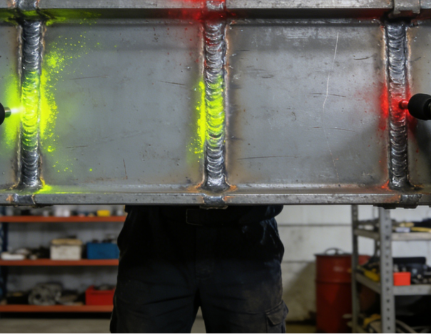
Magnetic Particle Testing (MT) and Dye Penetrant Testing (PT) are effective for detecting surface cracks in welds and heat-affected zones.
Ultrasonic Testing (UT) is essential for identifying internal defects and assessing crack depth.
Strain Gauge Monitoring: Critical load-bearing members are instrumented to measure real-time stress spectra, allowing comparison against allowable fatigue limits.
Fracture Surface Analysis: In cases of failure, scanning electron microscopy (SEM) of the fracture surface reveals typical fatigue features (striations, beach marks), confirming the failure mode and aiding root cause analysis.
Design Phase: Follow classification society or national standards (e.g., FEM, F.E.M., GB/T 3811) to select appropriate working class (e.g., A5–A8) and corresponding fatigue strength requirements. Avoid abrupt cross-section changes and optimize weld details to reduce stress concentration.
Fabrication Quality: Strictly control welding processes, perform post-weld heat treatment to relieve residual stresses where necessary, and conduct 100% NDT of critical welds.
Operational Discipline: Avoid overload operation, reduce impact loading, and implement scheduled rotation of loads in multi-shift operations to control cumulative usage.
Regular Inspection: Establish a fatigue life management plan based on the remaining fatigue life (RFL) methodology. Periodically inspect known high-stress zones and document any crack indications.
Fatigue
failure is a progressive and cumulative process. For lifting machinery,
relying solely on static strength design is insufficient; a fatigue design philosophy must be integrated with rigorous quality control and systematic condition monitoring.
Early detection of fatigue cracks and timely remediation are the most
effective means of preventing catastrophic structural failures.